
Short answer: A beginner's rotary tool kit for glass engraving needs more than a motor and an engraving label: it needs a glass-suitable accessory, secure fit, usable speed instructions, stable work support and appropriate eye and respiratory protection. Cordlrotar documents its kit for engraving and lists a digital display plus forward and reverse control, but it does not specify glass compatibility, accessory contents, shank sizes or speed range. Dremel's manufacturer guide shows a cautious learning method using a transferred design, purpose-suited points or stones and light repeated passes. Confirm that an equivalent documented method is compatible with this kit before practising on inexpensive, undamaged glass.
What a beginner glass kit must establish
The tool, accessory and glass must be treated as one system. A point may be suitable for glass but incompatible with the tool's collet, or it may fit physically while requiring a speed the tool cannot document. Resolve both questions before switching on.
The Cordlrotar page identifies TK-RPT-G but does not provide an itemised accessory list. The manufacturer does not specify whether a glass point, spare collet, charger or practice material is included.
| Beginner requirement | Current evidence | Required confirmation |
|---|---|---|
| Rotary tool | Cordless lithium tool with display | Actual speed range and control instructions |
| Glass accessory | Not itemised | Material approval, shank fit and speed limit |
| Direction | Forward and reverse are listed | Permitted direction for the selected point |
| Protection and support | Not described by retailer | Suitable PPE and a stable method for the object |
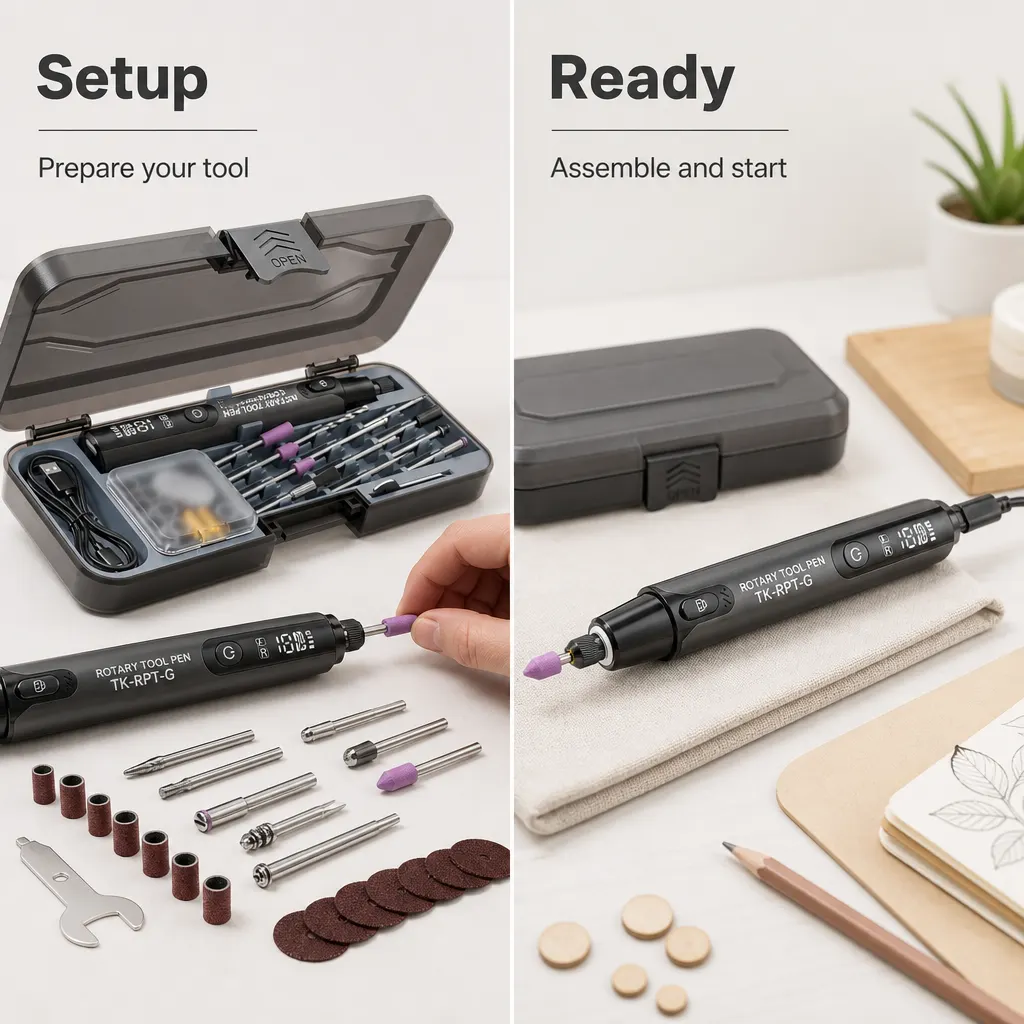
Use a practice sequence with low stakes
Dremel's glass guide begins by transferring a design and choosing a purpose-suited burr. For a first session, use a simple outline on a non-valuable item so errors in pressure, viewing angle or line placement do not ruin a keepsake.
- Inspect the practice glass and reject any item with damage or uncertain treatment.
- Transfer a short design that can be viewed straight on.
- Fit a verified glass accessory securely and check its permitted speed.
- Wear suitable eye and respiratory protection and stabilise the object.
- Follow the outline with light passes, stopping frequently to inspect.
Learn from the mark instead of forcing depth
Dremel recommends building the design with light passes and repeating where a stronger mark is wanted. This is a technique principle, not a speed setting for the Cordlrotar tool. Use the actual accessory and tool instructions for settings.
If the accessory chatters, shifts in the holder, creates uncontrolled fragments or makes the glass visibly unstable, stop. Do not press harder to compensate for an unverified accessory or unsuitable setup.
Limits of the Cordlrotar listing
The manufacturer does not specify glass compatibility, included glass points, chuck or collet sizes, speed range, runout, vibration, runtime, certification or suitability for drinkware. Those are purchase questions, not details a beginner should discover during use.
Dremel's guide calls for eye and respiratory protection and supported work where practical, while HSE says PPE must match hazards such as dust and projectiles. Choose a different, fully documented kit if these conditions cannot be confirmed.
- Confirmed glass accessory and shank fit
- Documented speed and direction limits
- Undamaged practice glass
- Stable work support
- Suitable eye and respiratory protection
Related guides and product details
For a first glass project, buy only when the kit's accessory fit and operating limits are documented; otherwise choose a glass-specific system with clear instructions. Read Cordless Engraving Pen UK: What to Verify for related guidance. Read Cordless Rotary Tool Buying Considerations for related guidance. Review the documented specification on the Cordless rotary tool kit with digital display product page before ordering.
Sources and safety context
- Supports the general engraving function, controls and the limits of the written package specification. Current Cordlrotar product page.
- Supports purpose-suited accessories, design transfer, light passes, PPE and work support. Dremel step-by-step glass engraving guide.
- Supports matching eye and respiratory protection to dust and projectile hazards. Using personal protective equipment to control risks at work.